Gulliver’s Travels. Utopian or Dystopian?
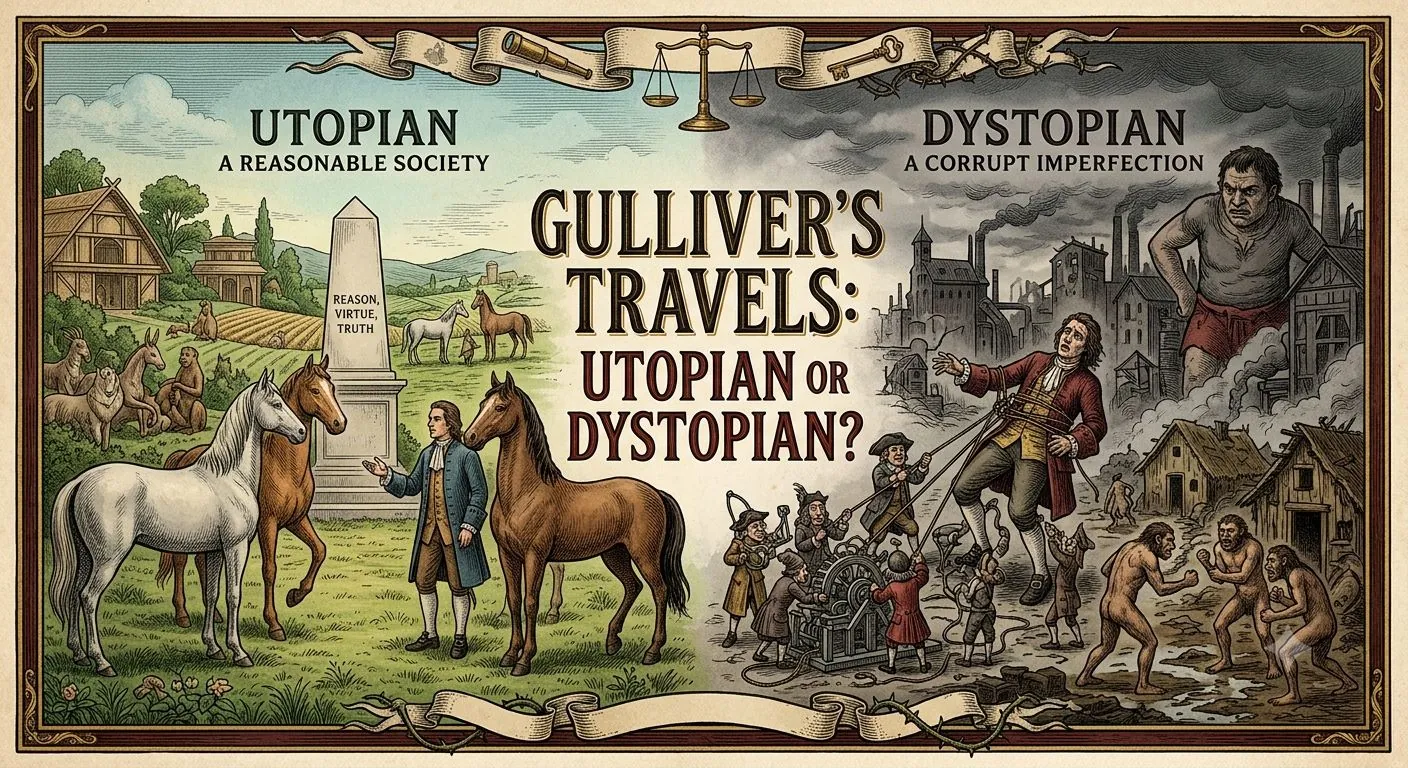
Picture waking up one morning and finding everyone around you small. Then picture travelling to another place and seeing giants everywhere. In between you might find a floating island of people who love science and later a society ruled by clever horses. That seems like an idea for an odd adventure story.. Jonathan Swift’s Gulliver’s Travels wants to make us feel uneasy rather than just amuse us.
The odd lands Gulliver goes to might not be on any map but the issues he sees there feel very familiar. Politics, war, pride, science, power and human behaviour appear in every part of the book. Swift builds made‑up societies so that we can examine our own closely. That is why it is hard to decide if Gulliver’s Travels is utopian or dystopian. Each time we think we have found a society Swift quietly shows us a flaw.
When Gulliver first arrives in Lilliput, the small size of its people makes everything look almost funny.. The humour has a sharp bite. The Lilliputians are obsessed with politics and power. Their fights often come from silly differences. Their world is tiny. Their ambitions are huge. It is hard not to laugh at them until we understand that Swift does not want us to laugh at Lilliput. Swift wants us to see ourselves.
People have always turned differences into big fights. We make rules pick sides fight for control. Then convince ourselves that the matters we argue about are very important. By shrinking the world of politics Swift makes its absurdity easier to spot.
Then Gulliver reaches Brobdingnag and the joke flips. He becomes the one. The people around him are huge. Their size gives them a different view of Gulliver’s world. When Gulliver boasts about society with its wars and weapons the King of Brobdingnag is shocked. What Gulliver calls civilisation sounds cruel to someone who sees it from outside.
That shift in view is one of the interesting things Swift does. Often we become so used to our society that we stop noticing how odd it is. We call something progress because everyone around us calls it progress. We call something civilisation because we have been taught to see it that way. It may take an outsider or a giant to make us question it.
The third trip takes Gulliver to Laputa, a floating island where people are deeply involved in maths, science and abstract ideas. Their intelligence is impressive. It is almost ridiculous how far removed they are from everyday life. Swift does not simply mock knowledge. Swift asks what happens when knowledge is detached from life. What benefit is an idea if the holder of it cannot understand the people in front of them?
Then we reach the Houyhnhnms and the book becomes much darker. These clever horses live by reason. They seem peaceful orderly and free from many of the flaws that Gulliver sees in humans. At first they seem like the thing the book offers to a utopian society. But the more Gulliver admires them the more uneasy the reader may feel.
Their perfection feels frightening. There is room for the emotional contradictions that make humans complex. Their society may be rational. Rationality alone does not automatically make a society compassionate. A world without foolishness may also lack some qualities that give human life meaning.
This may be why Swift never offers an utopia. Every society Gulliver visits contains something and something unsettling. Lilliput shows absurdity. Brobdingnag questions civilisation. Laputa makes us think about knowledge that lacks wisdom. The Houyhnhnms make us wonder if perfection itself can become oppressive.
So perhaps Gulliver’s Travels does not ask us to choose between utopia and dystopia. It asks us to be suspicious of both. A society can look perfect, from away yet be deeply flawed once we step inside.
That idea feels surprisingly modern. We still believe that the next invention, system, educational model or technological development might finally solve the problems we have faced for generations. We keep searching for the answer.
Swift however seems to suggest that the problem may not always be the system.
Sometimes the problem is us.
Perhaps that is why Gulliver’s Travels has survived for so long. I think we may no longer travel to lands of giants and talking horses. We are still trying to build our own versions of paradise. Gulliver’s Travels reminds us that Swift simply tells us to look before we decide that we have found paradise.