Metaphor vs. Simile: Differences and Examples in Poetry
Poetry often makes us see familiar things differently. A broken heart becomes a shattered window. A quiet evening feels like a painting. A memory turns into a room we can never enter again. These transformations happen through figurative language, which allows writers to express emotions and ideas beyond their literal meanings.
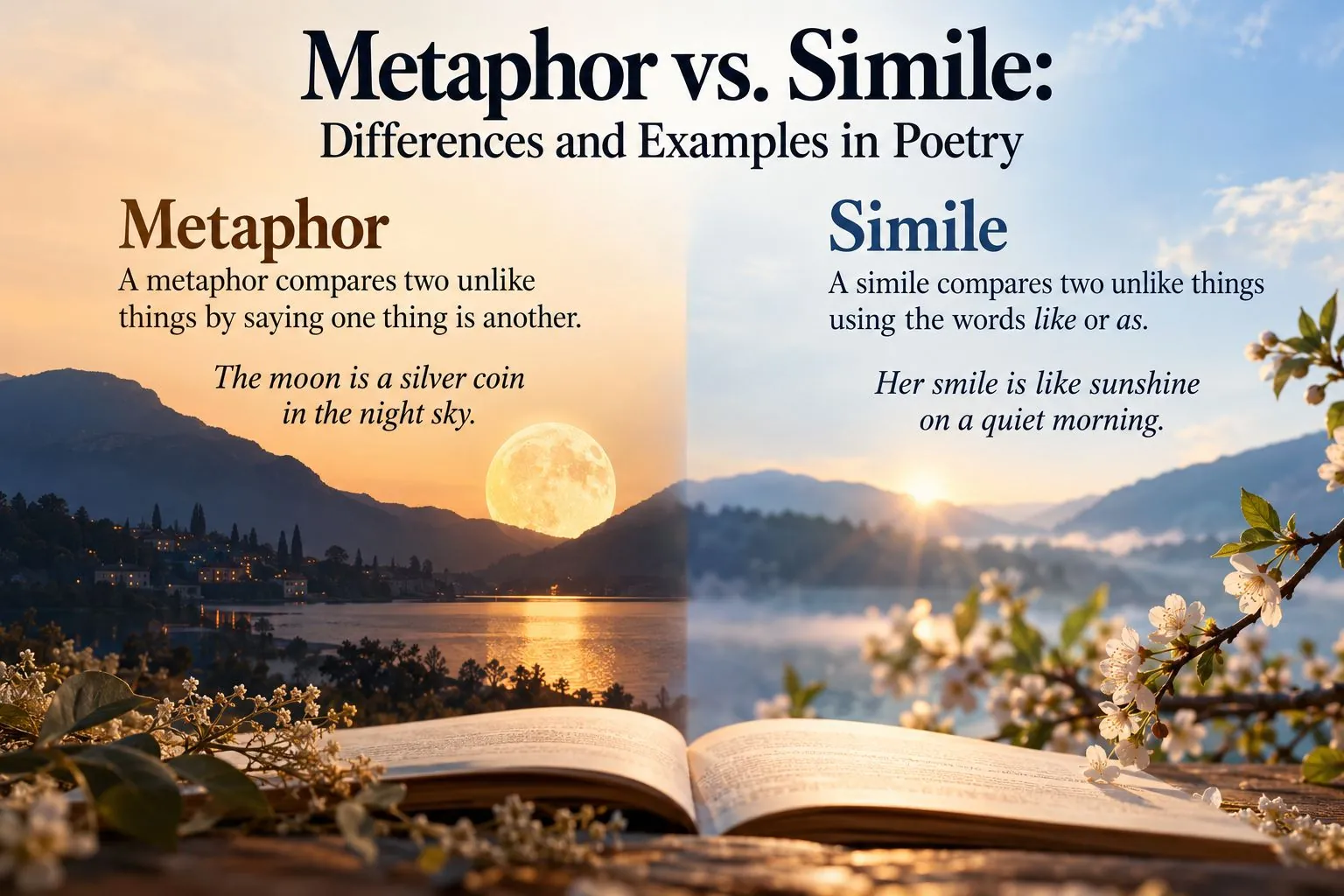
Two of the most widely used figures of speech are metaphor and simile. Both compare different things to reveal a shared quality, but they do so in different ways. A metaphor describes one thing as another, while a simile makes the comparison explicit, usually with words such as like or as.
Understanding the difference between these techniques can help you read poetry more closely, recognize the choices poets make, and write lines that leave a lasting impression.
What Is a Metaphor?
A metaphor is a figure of speech that describes one thing as another to suggest a connection between them. Rather than stating that two things are similar, a metaphor brings them together directly.
Consider this example:
The moon is a silver coin in the night sky.
The moon is not literally a coin. The comparison connects its round shape, pale shine, and apparent distance to a silver coin. Instead of explaining these qualities separately, the metaphor combines them into one image.
Metaphors can make abstract ideas feel concrete. Love may become a flame, grief may become a storm, and hope may become a seed waiting beneath the soil.
Examples of metaphors in poetry
1. “Hope is a small bird.”
Hope is not a bird, but the image suggests something delicate, alive, and capable of enduring difficult conditions. It encourages the reader to imagine hope as a living presence rather than an abstract emotion.
2. “Her words were daggers.”
Words cannot literally become daggers. This metaphor conveys the sharpness of someone's speech and the emotional pain it causes. It makes an ordinary conversation feel dangerous.
3. “Memory is a house with locked rooms.”
This metaphor presents memory as a place containing experiences that cannot always be accessed. Some memories remain vivid, while others feel distant or impossible to understand.
4. “The city is a restless ocean.”
The metaphor captures movement, noise, unpredictability, and the constant activity of urban life. It encourages readers to imagine streets and crowds as waves moving through a vast body of water.
Why poets use metaphors
Metaphors do more than decorate a line. They shape how readers understand an experience.
When a poet calls grief a storm, the reader may imagine darkness, disruption, and a force that cannot easily be controlled. When grief becomes a room, the feeling may seem enclosed, quiet, and difficult to leave.
The comparison influences the emotion as much as the meaning.
Metaphors are especially useful when writing about experiences that are difficult to explain directly, such as loneliness, identity, desire, faith, or the passage of time. They allow poets to give these experiences a physical form.
What Is a Simile?
A simile is a figure of speech that compares two different things using words such as like or as. It identifies a shared quality while keeping the two things distinct.
Consider this example:
Her smile was like sunshine after a long winter.
A smile is not sunshine. The comparison suggests warmth, comfort, brightness, and renewed happiness. The reference to winter also creates a sense of relief because sunshine appears after a period of cold and darkness.
Unlike a metaphor, which directly identifies one thing with another, a simile signals that the relationship is a comparison.
Examples of similes in poetry
1. “The river moved like a ribbon through the valley.”
The comparison emphasizes the river's long, winding shape. A ribbon also suggests smoothness and elegance, helping readers picture the landscape.
2. “His silence was as heavy as stone.”
Silence has no physical weight, but the simile presents it as a burden. It suggests tension, discomfort, or words left unspoken.
3. “Her laughter rang like bells in the morning.”
The sound of laughter is compared with the clear, bright ringing of bells. The image creates a sense of joy and liveliness.
4. “The stars scattered like seeds across the dark field.”
This simile transforms the night sky into a field. It emphasizes the stars' distribution across the darkness and suggests the possibility of growth or new beginnings.
Why poets use similes
Similes give readers a recognizable point of reference. They can make an unfamiliar emotion easier to understand by connecting it to something familiar.
A writer describing nervousness might compare it to a trapped bird beating its wings. A poet describing a peaceful afternoon might compare it to a slow-moving stream.
Similes can also create distance between two ideas. Saying someone is like a lion suggests courage without claiming that the person is literally an animal.
That distinction gives writers considerable flexibility. They can emphasize one quality without making the comparison absolute.
Metaphor vs. Simile: The Main Differences
Both devices rely on comparison, but their structures and effects differ.
Metaphor: The classroom was a zoo.
Simile: The classroom was like a zoo.
The metaphor identifies the classroom as a zoo, creating a direct and forceful image of disorder. The simile explicitly compares the classroom to a zoo, making the figurative relationship more apparent.
Neither form is automatically better. The right choice depends on the meaning, tone, and rhythm a writer wants to create.
Metaphor
Describes one thing as another.
Usually does not require like or as.
Can create a direct, immersive image.
Often encourages readers to explore several layers of meaning.
Example: Time is a thief.
Simile
Compares two things explicitly.
Often uses like or as.
Can make a quality easier to recognize or imagine.
Allows a writer to clarify the particular similarity being emphasized.
Example: Time moves like a thief in the night.
Both examples concern time, but they produce slightly different impressions. The metaphor suggests that time takes something away from us. The simile develops the image of time moving quietly and secretly.
Famous Examples of Metaphor and Simile in Poetry
Studying established poets is one of the best ways to understand how comparisons work. Their images often carry meanings beyond the first impression.
1. Robert Burns: Love as a Red Rose
In A Red, Red Rose, Robert Burns opens with the famous lines:
O my Luve's like a red, red rose That's newly sprung in June;
Although this passage uses a simile rather than a metaphor, it provides a useful example of poetic comparison. The beloved is compared to a rose that has recently bloomed.
The rose suggests beauty, freshness, and vitality. The reference to June reinforces the sense of new life and seasonal abundance. The repeated word red adds intensity to the image.
Burns shows that a comparison can communicate emotional meaning through a familiar object. The rose is not simply a description of appearance; it becomes a way of expressing affection.
This example also demonstrates why it is important to distinguish between a device's grammatical form and its broader poetic function. A comparison can be vivid and layered without being a metaphor.
2. William Shakespeare: Life as a Performance
In As You Like It, William Shakespeare writes:
All the world's a stage, And all the men and women merely players;
This is one of the most recognizable metaphors in English literature.
Shakespeare presents the world as a stage and people as actors. The comparison suggests that human life involves roles, entrances, departures, and changes over time.
The metaphor develops throughout the speech, moving through the different stages of a person's life. Because the initial comparison continues across several lines, it becomes an extended metaphor.
An extended metaphor allows a poet or writer to explore an idea through a connected series of images rather than a single comparison. Shakespeare uses the theatre to examine identity, aging, and the temporary nature of human experience.
3. Emily Dickinson: Hope as a Bird
In “Hope” is the thing with feathers, Emily Dickinson describes hope as a bird that perches within the soul and continues to sing.
The central metaphor turns an abstract emotion into a living creature. The bird's song suggests persistence, while its presence within the soul makes hope feel intimate and enduring.
The image is particularly effective because it combines fragility with resilience. A bird is small and vulnerable, yet it can continue singing even when conditions become difficult.
Dickinson's metaphor does not explain hope through a definition. Instead, it invites readers to experience hope through movement, sound, and the presence of a living thing.
4. William Wordsworth: The Poet as a Cloud
In I Wandered Lonely as a Cloud, William Wordsworth begins:
I wandered lonely as a cloud That floats on high o'er vales and hills,
The simile compares the speaker's wandering with the movement of a cloud. The image suggests solitude, lightness, and a sense of drifting through the natural world.
The comparison also establishes the poem's relationship between the individual and the landscape. The speaker initially appears separate from the world below, but the poem later describes a field of daffodils that transforms his experience.
Wordsworth demonstrates how a simile can establish mood and prepare the reader for a change in perspective.
5. Epic Similes: Comparisons That Tell a Story
Epic poetry often uses elaborate comparisons known as epic similes or Homeric similes. These comparisons can extend over several lines, developing a scene in detail before returning to the main action.
An epic poet might compare a warrior's movement to a lion crossing a plain or an army's advance to a storm sweeping over the land.
Such comparisons do more than describe an action. They connect human events to the natural world, introduce additional emotional associations, and give a scene greater scale.
Epic similes demonstrate that a simile does not need to be brief. The comparison may become a substantial part of the poem's storytelling.
Can a Line Be Both a Metaphor and a Simile?
A single comparison is usually classified according to how it is expressed, but a poem can use both devices together.
Consider these original examples.
Metaphor:
Her heart was a locked garden.
This is a metaphor. The heart is described as a garden, suggesting that the person's emotions are protected or difficult to access.
Simile:
Her heart was like a locked garden, quiet behind its walls.
This is a simile because the word like introduces the comparison. The additional description develops the image further.
A poet could also combine both techniques in a passage:
His memories were winter, cold and still. Each one lay like a fallen leaf beneath the snow.
The first sentence uses a metaphor: memories are described as winter. The second uses a simile: individual memories are compared with fallen leaves.
Using both devices can create a more developed image, but the comparisons should work together. If every line introduces a completely unrelated image, the poem may feel scattered rather than unified.
How Metaphors and Similes Change the Meaning of a Poem
The choice between a metaphor and a simile affects more than sentence structure. It influences how readers imagine an experience.
Consider the emotion of loneliness.
Metaphor: Loneliness is an empty station.
Simile: Loneliness feels like waiting alone at an empty station.
The metaphor makes loneliness and the station seem directly connected. It compresses the experience into a single image, allowing the reader to supply details such as silence, distance, and departure.
The simile describes the experience more explicitly. The reader is invited to imagine the act of waiting, the absence of other people, and the possibility that someone may never arrive.
Both comparisons communicate isolation, but they direct the reader's attention differently.
Metaphors create identification
When a writer says, Her voice was music, the comparison invites the reader to understand the voice through qualities associated with music: harmony, beauty, rhythm, or emotional power.
The metaphor makes those qualities part of the description itself.
Similes create a point of reference
When a writer says, Her voice sounded like music, the comparison preserves a distinction between the voice and music.
That difference can make the description feel more observational. It draws attention to a particular quality without fully merging the two things.
Context determines the effect
Neither device always produces a specific emotional response. A metaphor can be gentle, humorous, or uncertain. A simile can be dramatic, intimate, or unsettling.
The surrounding words, rhythm, sound, and subject matter determine how the comparison functions.
Figurative language also appears outside traditional poetry. Songwriters, for example, use comparisons to communicate identity, relationships, conflict, and social experience. The techniques that make a poetic image memorable can also shape the narratives explored through hip-hop storytelling.
How to Write Better Metaphors
Strong metaphors reveal something meaningful about the subject. They do not simply replace a literal word with a decorative image.
1. Begin with a feeling or idea
Choose something you want to express, such as regret, freedom, ambition, or grief.
Ask yourself what that experience feels like. Does regret resemble a room that cannot be left? Does ambition feel like a fire that keeps demanding fuel?
You do not need to use the first comparison that comes to mind. Explore several possibilities and choose the one that captures the experience most accurately.
2. Look for an unexpected connection
Common metaphors can be effective, but familiar expressions sometimes lose their impact through repetition.
Instead of writing my heart was broken, you might explore a more specific image:
My heart was a window cracked by winter.
The window suggests fragility, while winter introduces coldness and hardship. The image gives the reader more to interpret than the familiar expression alone.
Originality does not mean making a comparison obscure. A fresh metaphor should still help the reader understand the subject.
3. Develop the image consistently
If you describe grief as a storm, consider the qualities of that storm. Does it arrive suddenly? Does it damage familiar surroundings? Does it eventually pass?
You can develop the metaphor through related details:
Grief was a storm at the door. It rattled every window and left the garden changed.
The storm remains central throughout the passage. This consistency helps the reader follow the emotional movement.
4. Avoid overcrowding a line
Too many unrelated metaphors can make a poem difficult to follow.
For example:
My heart was a burning ocean, a shattered clock, a bird beneath the mountain.
Each image might work independently, but together they compete for attention.
Try developing one strong comparison before introducing another. A clear image often has more emotional power than several loosely connected ones.
How to Write Better Similes
A good simile gives readers a useful point of comparison. The two things do not need to be similar in every respect; they only need to share a quality that matters to the poem.
1. Identify the quality you want to emphasize
Before choosing a comparison, ask what the reader should notice.
If you want to describe speed, you might compare something to an arrow. If you want to communicate fragility, you might compare it to thin ice.
For example:
Her patience was as thin as winter ice.
The comparison emphasizes how easily the patience might disappear or break.
2. Be specific
A vague comparison may communicate very little.
The night was like something dark.
This does not give readers a clear image. A more specific simile could be:
The night spread like ink across the page of the sky.
The comparison connects darkness with ink spreading across a surface. It gives the image movement and a recognizable visual quality.
3. Think beyond appearance
Similes can compare sounds, sensations, emotions, movements, and ideas.
The news struck like a sudden clap of thunder.
Her thoughts moved like fish beneath still water.
The silence stretched as long as an unending road.
These comparisons engage different aspects of experience rather than relying only on visual description.
4. Read the line aloud
A simile may look effective on the page but interrupt the poem's rhythm.
Read it aloud and listen for awkward phrasing, unnecessary words, or a comparison that feels too predictable. Revise until the image sounds natural within the poem.
Common Mistakes to Avoid
Treating every comparison as a metaphor
Not every comparison is a metaphor. A phrase such as the child ran like the wind is a simile because it explicitly uses like to compare the child's speed with the wind.
A metaphor would be: The child was the wind racing down the road.
Using like or as without making a comparison
The presence of these words does not automatically create a simile.
In the sentence She likes the rain, the word likes expresses preference. It does not compare two different things.
Similarly, as the sun rose describes the timing of an event rather than making a figurative comparison.
Choosing a comparison that adds no meaning
A comparison should help the reader see, hear, or understand something.
If the image merely repeats information already obvious from the sentence, it may not be necessary. Ask what the comparison contributes to the poem's meaning or emotional effect.
Mixing images without a clear purpose
A poem can deliberately combine images, but accidental shifts can confuse the reader.
If the central metaphor describes love as a garden, images of seeds, roots, flowers, and seasons may help develop it. Suddenly introducing engines, oceans, and burning buildings may weaken the original image unless the contrast is intentional.
Explaining every image
Writers sometimes follow a vivid comparison with a sentence that explains exactly what it means. This can reduce the reader's opportunity to interpret the poem.
Trust the image when it communicates clearly. Let readers participate in making meaning.
Practice: Metaphor or Simile?
Try identifying the figure of speech in each example before reading the answers.
1. The classroom was a beehive of activity.
2. Her eyes shone like stars.
3. Anger is a fire that consumes the mind.
4. The old road twisted like a sleeping snake.
5. His promise was a bridge across the distance.
Answers
Metaphor: The classroom is described as a beehive, suggesting busy movement and activity.
Simile: The word like introduces a comparison between eyes and stars.
Metaphor: Anger is identified as fire, suggesting destructive intensity.
Simile: The road is compared with a sleeping snake using like.
Metaphor: A promise is described as a bridge, suggesting connection and the possibility of overcoming separation.
Try writing your own
Choose one of these subjects: fear, friendship, a rainy evening, or a childhood memory.
First, write a metaphor that describes it. Then rewrite the same idea as a simile.
For example:
Subject: A childhood memory
Metaphor: Childhood was a garden behind a forgotten gate.
Simile: Childhood memories returned like flowers after the rain.
Notice how the metaphor presents childhood as a place, while the simile compares returning memories to flowers appearing after rainfall. The second image emphasizes renewal; the first emphasizes a place that remains meaningful even when it has been left behind.
Repeating this exercise with different subjects will help you develop a more flexible approach to figurative language.
Frequently Asked Questions
What is the main difference between a metaphor and a simile?
A metaphor describes one thing as another, while a simile explicitly compares two things, usually with like or as. For example, the world is a stage is a metaphor, while the world is like a stage is a simile.
Which is more powerful in poetry: metaphor or simile?
Neither is universally more powerful. A metaphor can make an image feel direct and immersive, while a simile can clarify a particular resemblance. The best choice depends on the poet's purpose, tone, and intended effect.
Can a metaphor use the words like or as?
A conventional simile generally uses like or as to signal comparison. However, these words can also appear in literal statements or other grammatical constructions. Their presence alone does not determine whether a phrase is figurative.
What is an extended metaphor?
An extended metaphor develops a comparison across several lines, a stanza, or even an entire poem. Shakespeare's description of the world as a stage in As You Like It is a well-known example because the theatrical comparison continues as the speech explores different stages of life.
What is an epic simile?
An epic simile is an elaborate comparison, often extending over multiple lines, found particularly in epic poetry. It develops a comparison in detail before returning to the main action.
Why are metaphors and similes important in poetry?
They help poets communicate abstract ideas through concrete images, create emotional connections, establish atmosphere, and encourage readers to interpret meaning. They can also make a poem more memorable by connecting an experience to an image readers can imagine.
Conclusion
Metaphors and similes are two of poetry's most versatile tools. Both connect different things to reveal a shared quality, but they create different relationships between the subject and the image.
A metaphor says, Time is a thief. A simile says, Time moves like a thief in the night. The first makes a direct identification; the second develops an explicit comparison.
Neither technique requires complicated language to be effective. A simple image can communicate a complicated emotion when the comparison is precise, original, and connected to the poem's larger meaning.
When writing poetry, begin with what you want the reader to feel or understand. Then experiment with different images. Ask whether a direct identification or an explicit comparison communicates the experience more clearly.
The aim is not to use as many figures of speech as possible. It is to find the image that makes an experience feel real.