Seeing Like a Feminist. Learning to Question the Ordinary
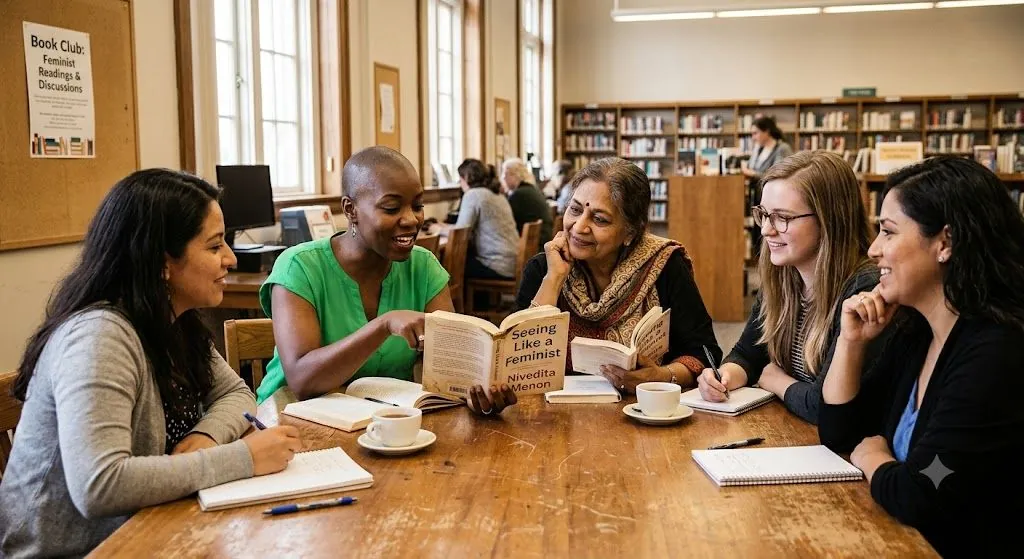
Some books change what we know. Others change what we notice. Nivedita Menon’s Seeing Like a Feminist is in the group. It does not simply ask us to learn a set of ideas about feminism. It asks us to look at things again and wonder why they have become ordinary in the first place.
We rarely pause to question the rules we grow up with. A girl is told to come early because it is safer. A boy is told not to cry because he must be strong. A daughter is expected to learn cooking because she will "need it later." A son may be allowed to focus on studies or career. None of these moments feels like an argument when it happens. It is simply presented as life.
That is exactly where Menon’s ideas become interesting. What if "normal" is not always natural? What if some of the things we accept without thinking're actually ideas that society has repeated for so long that we have forgotten they can be questioned?
This does not mean that every woman who cooks is oppressed or every man who works outside the home is privileged. The point is much simpler and more uncomfortable: do people have a choice or are they being pushed into a role because of their gender?
Take housework. Cooking, cleaning, childcare and caring for family members are forms of work. Yet much of this labour happens quietly inside homes without salaries or professional recognition. Because we are used to seeing it as part of family life we sometimes forget that it takes time, energy and skill. Menon’s feminist perspective encourages us to notice this labour and ask why it is so often treated as a woman’s responsibility.
The same thing happens with marriage. We often talk about marriage as though it is entirely private belonging to two people.. The expectations surrounding marriage rarely come from the couple alone. Families, traditions and society often have ideas about where a couple should live who should compromise, who should earn who should look after children and what a "good wife" or "good husband" should look like.
Once you start noticing these expectations they appear everywhere.
Even the language we use can reveal them. A woman who is ambitious may be called " career-oriented." A man who is deeply involved in his children’s lives may be praised as a caring father. A woman doing something expected of her can become invisible while a man doing the thing can receive recognition for it.
Menon also makes it difficult to imagine feminism as one experience. Women do not all live the lives. Gender intersects with caste, class, sexuality, religion, economic status and many other parts of identity. A secure woman and a woman struggling to survive may face gender inequality differently. Their problems may overlap,. They cannot simply be placed into the same box.
That complexity is important because feminism is often reduced to an argument between men and women. Seeing Like a Feminist offers something useful: a way of thinking about power and choice. It encourages us to ask who gets freedom, who is expected to compromise and whose work is treated as valuable.
Perhaps feminism becomes most interesting when we stop thinking about feminism as something that happens somewhere else.
It happens at home. It happens in classrooms. It happens at workplaces. It happens in relationships.
It happens when a girl is told that a certain career is "not suitable" for her. It happens when a boy is made fun of for showing emotion. It happens when a woman is expected to manage a household even while working a full-time job. It happens when a man is assumed to be responsible for money simply because he is a man.
These expectations can affect everyone.
That is one of the things I find interesting about looking at feminism this way. It is not about giving women more opportunities. It is also about questioning the roles given to men. If women are expected to be endlessly caring men are often expected to be endlessly strong. If women are told to sacrifice men are often told that providing is their responsibility. Neither expectation is as simple as it appears.
Perhaps then the important lesson, from Seeing Like a Feminist is not a definition of feminism. The habit of questioning is the lesson.
I wonder why this is expected from the woman, the woman? I feel it is unfair. I wonder why he is allowed to do that the man? I think it is unjust. I wonder who decided this was normal normal? I question that decision. I wonder what would happen if we did things differently differently? I imagine possibilities.
Sometimes change does not begin with a revolution. Sometimes change begins with noticing something that has been in front of us, for a time noticing. I think small steps matter.
Then finally asking why why. I feel curiosity.